
Andis Dog Clipper Blades
Grooming a dog well is mostly a matter of picking the right blade, and Andis's detachable UltraEdge and CeramicEdge blades give you a size for every job - from a full-length trim to a surgical-close pad clean-up. The number stamped on the blade tells you how much hair it leaves, and the letter after it tells you how it cuts. This page covers the sizes dog groomers actually reach for, how skip-tooth and finish blades differ, and how to match a blade to the coat in front of you.
The blades most dog groomers use
You do not need the whole range. A handful of sizes covers almost every dog:
- #10 - the workhorse. Leaves about 1/16 inch. Sanitary trims, bellies, pads, and clean-up around the face and ears on most breeds.
- #7F - a short, tidy body clip that still leaves enough coat to protect the skin. A staple for pet trims.
- #5F / #4F - progressively longer body clips, leaving roughly 1/4 to 3/8 inch. Comfortable all-over lengths for many pets.
- #3.75 - the longest full-tooth detachable blade, leaving about 1/2 inch for a fuller finished look.
- #30 and #40 - very close, mainly used under snap-on guard combs or for surgical-close work such as poodle feet and faces, and for show prep.
Buying one blade in the length you use most, plus a #10 for tidy-up, handles the majority of everyday grooming.
Andis dog blade sizes at a glance
The number is the cut length; match it to the job before you order. Exact fractions for every size are on the Andis blade size chart.
| Blade | Leaves roughly | Typical dog use |
|---|---|---|
| #3.75 | 1/2 in | Full, fluffy finish; longest full-length clip |
| #4F | 3/8 in | Longer all-over body clip |
| #5F | 1/4 in | Medium body clip, comfortable pet length |
| #7F | 1/8 in | Short, tidy body clip - a grooming staple |
| #10 | 1/16 in | Sanitary areas, pads, belly, face and ear clean-up |
| #15 | 3/64 in | Closer clean-up and detailing |
| #30 / #40 | 1/50 - 1/100 in | Surgical-close work; base blade under guard combs |
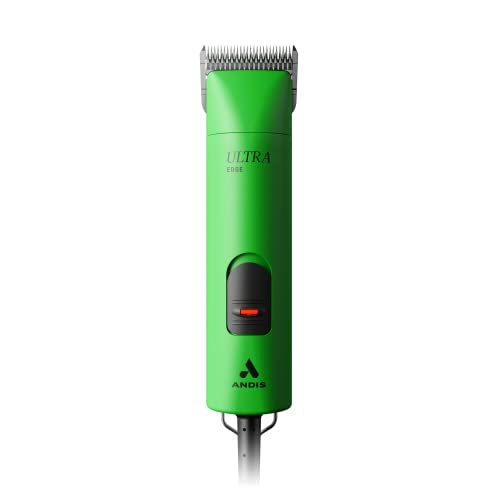
Popular options on Amazon
Prices change often - check the current price on Amazon.




Skip-tooth or finish (F) blades
The letter matters as much as the number. A blade with no letter - a skip-tooth blade - has alternating tall and short teeth. It bites into thick, matted or dirty coats that a fine blade would jam on, but it leaves a slightly uneven surface and can catch skin more easily, so it is a rough-in tool, not a finishing one.
An F blade (for finish) has every tooth the same height, set close together. It leaves a smooth, even coat at the same cut length and is far safer against skin, which is why the everyday body sizes - #4F, #5F, #7F - are almost always bought in the F version for pet work. Use a skip-tooth to knock down a heavy coat, then a matching F blade to finish it.
Matching the blade to the coat
Start from the coat, not the number. On a matted or heavily tangled dog, go shorter than feels comfortable - a #7F or even a #10 under the mats is kinder than dragging a long blade through them, and cutting under the mat is the only safe way to clear it. On a double-coated breed, avoid shaving down to the skin: it damages the coat's insulation and it does not always grow back the same. For a full, fluffy finish, the #3.75 or #4F holds length while still tidying the shape. For poodle feet and faces and other close detail, a #10, #15 or #30 gets in cleanly. When you want a body length between the blade sizes, a snap-on guard comb over a #30 or #40 extends the cut - the Andis clipper guards page covers how those combs map to lengths.
UltraEdge or CeramicEdge for dogs
Both systems share the same mounting and the same size numbers, so any clipper that takes one takes the other, and the cut length is identical. The difference is heat. UltraEdge is all steel and the sensible, cheaper choice for a pet groomed now and then at home. CeramicEdge pairs a ceramic cutter with a steel still blade; ceramic runs cooler over a long session and holds its edge longer, which matters when you are working through a thick double coat or grooming several dogs in a row. Hot blades are the main cause of clipper burn and of dogs that will not sit still, so on heavy coats the cooler blade earns its price. The systems are compared in full on the Andis clipper blades guide.
Keeping dog blades cutting and cool
Dog coats are hard on blades - dirt, dander and dense hair dull and heat an edge faster than human hair does. Oil the blade across the teeth before and during each session, brush the packed hair out from underneath between dogs, and keep a spare in your busiest size so you can swap to a cool blade rather than pushing a hot one against the skin. If a blade suddenly pulls or stops cutting mid-groom, it is almost always dry, packed or misaligned rather than worn - the fixes are on the clipper not cutting guide.
Frequently Asked Questions
What Andis blade is best for dogs?
What is the difference between a #7 and a #7F blade?
What blade should I use on a matted dog?
Can I use Andis dog blades on any Andis clipper?
How do I get a length between the blade sizes on a dog?
Why does my dog blade get so hot?
Ready to check the latest price?
Find Andis Dog Blades on Amazon