
Andis Blade Size Chart
Two numbering systems run alongside each other in opposite directions, and mixing them up is how people order a blade expecting a trim and receive one that cuts to the skin. Blade numbers go up as the cut gets shorter. Guard numbers go up as the cut gets longer. Everything else on this page follows from that.
Detachable blade numbers
| Blade | Leaves approx. | Typical use |
|---|---|---|
| #10 | ~1.5 mm | The common all-rounder, close work |
| #15 | ~1.2 mm | Slightly closer than a #10 |
| #30 | ~0.5 mm | Very close, often used under a guard |
| #40 | ~0.25 mm | Surgical, skin-close |
The shortest blades cut close enough to catch skin, so they are normally run under a guard rather than bare - the blade sets the base and the guard decides what you actually leave.
Numbers with an F or FC suffix denote a finish cut version, where the teeth are spaced more finely for a smoother result at the same nominal length.
Andis blade sizes for dogs
Grooming machines use the same detachable numbers, but the sizes that matter on a coat are the ones between the surgical blades and the guards. On animals the very short blades are normally run under a snap-on comb rather than bare, and the F (finish) blades - finer tooth spacing at the same length - are the ones used on the body.
| Blade | Leaves approx. | Common dog use |
|---|---|---|
| #3 3/4 | ~13 mm (1/2 in) | Longest full-coat blade, a fuller breed leave |
| #4F | ~9.5 mm (3/8 in) | Longer body clip |
| #5F | ~6.3 mm (1/4 in) | Medium body length |
| #7F | ~3.2 mm (1/8 in) | The usual short, neat body blade |
| #10 | ~1.5 mm (1/16 in) | Sanitary areas, paw pads, belly, ears |
| #30 / #40 | ~0.5 / 0.25 mm | Very close, run under a snap-on comb |
A practical starting point: a #7F for a tidy all-over clip, a #10 for the tidy-up work around pads and sanitary areas, and a snap-on comb over a short blade wherever you want to leave length. Coat type changes the result - the same blade leaves more on a dense double coat than on fine hair.
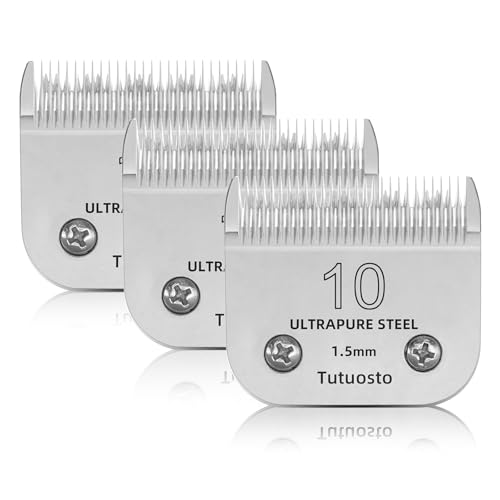
Popular options on Amazon
Prices change often - check the current price on Amazon.


Guard numbers, the other direction
Guards run in eighths of an inch: #1 leaves about 3 mm, #2 about 6 mm, #4 about 13 mm, #8 about 25 mm. Full table on the clipper guards page.
Practical consequence: ask which system someone means before acting on "a number two". A #2 guard leaves 6 mm; a #2 blade would be far shorter.
Reading a listing before you buy
Listings are inconsistent about which system they quote, so look for a length in millimetres or inches rather than trusting the number. "#10 - 1.5 mm" is unambiguous; "size 10" with no length could be either.
If a listing gives neither a length nor a compatible-model list, that is usually a generic import made to a common mounting pattern rather than for your clipper. Worth looking elsewhere.
Frequently Asked Questions
Is a #10 blade the same as a #10 guard?
What does the F in a blade number mean?
Which blade number is most used?
Why do two blades of the same number cut differently?
Which Andis blade should I use on a dog's body?
What blade is safe for a dog's paws and sanitary areas?
Ready to check the latest price?
Check Blades on Amazon