
Andis SMC Blade Cuts: Which Blades Fit and What Each One Leaves
Every blade cut in the Andis UltraEdge and CeramicEdge range fits the SMC - it uses the same snap-on detachable mount as the AG and AGC clippers. The cuts you will actually reach for run from #3¾ (about 13 mm) down to #40 (0.25 mm). Pick the cut by how much length you want to leave.
The SMC is a detachable-blade machine, which is the key to the whole blade list: the number on the blade sets the cut length, and you change length by swapping the blade rather than adjusting the clipper. Because the mount is shared across the detachable family, the full Andis cut range is available to you - the table below is the practical working list.
Which blades the SMC takes
The SMC belongs to the Andis detachable-blade family alongside the AG, AGC, BG and MBG clippers. Every one of them uses the same snap-on mount, so any blade sold as an UltraEdge or CeramicEdge detachable cut will click straight onto an SMC with no tools and no adapter.
That is what makes the “blade cuts for the SMC” question simpler than it looks: there is no SMC-specific blade. The machine accepts the standard detachable range, and the cut you end up with is decided entirely by the size number on the blade. If a blade lifts off with thumb pressure, it is the right kind for this clipper. For a wider look at which Andis machines share this mount and which do not, see the Andis clipper compatibility guide.
The full list of blade cuts for the SMC
These are the detachable cuts that fit the SMC, from the longest full-coat leave down to the surgical blades. The length is what the blade leaves on its own, before any snap-on comb is added over the top.
| Blade cut | Leaves approx. | Typical use on the SMC |
|---|---|---|
| #3 3/4 (3¾FC) | ~13 mm (1/2 in) | Longest full-coat leave, a fuller finish |
| #4F | ~9.5 mm (3/8 in) | Longer body clip |
| #5F | ~6.3 mm (1/4 in) | Medium body length |
| #7F | ~3.2 mm (1/8 in) | The usual short, neat body blade |
| #10 | ~1.5 mm (1/16 in) | All-rounder - sanitary areas, pads, belly, ears |
| #15 | ~1.2 mm | Slightly closer than a #10 |
| #30 | ~0.5 mm | Very close, usually run under a snap-on comb |
| #40 | ~0.25 mm | Surgical, skin-close |
The shortest cuts (#30 and #40) take hair close enough to catch skin, so on an animal they are normally run under a snap-on comb rather than bare. A longer first clip and a short tidy-up blade cover most jobs: a #7F for a neat all-over length and a #10 for the work around pads and sanitary areas. The full number-by-number reference lives on the Andis blade size chart.
Popular options on Amazon
Prices change often - check the current price on Amazon.


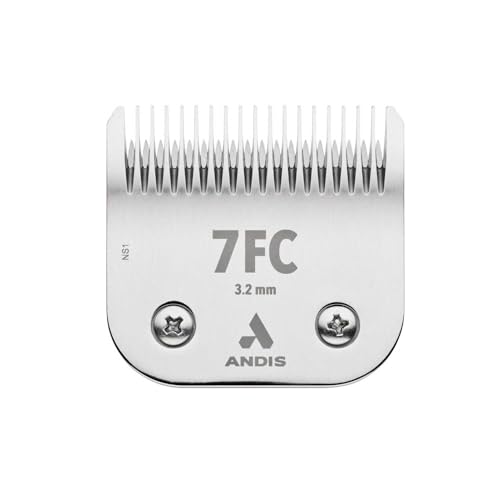

What the F, FC and plain numbers mean
The suffix on a cut tells you how the teeth are spaced, not a different mount. A plain number such as #10 is a standard tooth spacing. An F or FC suffix marks a finish cut - the teeth sit more finely at the same nominal length, so the result is smoother and catches fewer stray hairs. On the SMC the F blades are the ones most groomers keep for body work, because the finer spacing leaves a cleaner surface on a coat.
Cut length is set by the number; the suffix only changes the quality of the finish at that length. A #7F and a notional #7 leave roughly the same amount - the F version simply lays it down more evenly.
UltraEdge or CeramicEdge on an SMC
Both lines fit the SMC and share the exact same mounting, so the only decision is cutter material. UltraEdge is steel throughout - the workhorse, and the cheaper of the two to replace when a cut wears or chips. CeramicEdge pairs a ceramic cutter with a steel still blade; ceramic runs cooler over a long grooming session and holds its edge longer, at a higher price and with more risk of chipping if the blade is dropped.
For an SMC used for short sessions at home, steel is the sensible default. For a machine running coat after coat, the cooler blade earns its cost. The trade-off is set out in full on the UltraEdge vs CeramicEdge comparison, and the same mount means you can mix both lines across the cuts you own.
Stretching one cut with a snap-on comb
You do not need a blade for every length. A short blade with a snap-on comb over it gives a range of longer leaves from a single cut - the blade sets the base and the comb decides what stays. A #30 or #40 under a set of combs is a common way to cover the mid-lengths without owning the full blade range. The sizing on the combs runs the opposite direction to the blades; the Andis guard and comb sizes page lays out what each one leaves.
This is worth knowing before buying blades: a couple of cuts plus a comb set often covers more ground than a drawer full of individual blades.
If the SMC runs but will not cut
When an SMC turns over but leaves lines or drags through the coat, the blade is almost always the cause rather than the motor. A dry blade pulls and heats within a minute, so run a few drops of clipper oil across the teeth with the machine running before anything else. If a freshly oiled, sharp cut still will not take hair, check that the blade is seated fully on the mount and that the cutter is not sitting off to one side.
A blade that is dull or has a chipped tooth should be replaced rather than coaxed. The step-by-step checks - oil, seat, alignment, then blade - are on why an Andis clipper is not cutting, and the detachable blade range itself is covered on the Andis clipper blades hub.
Frequently Asked Questions
Does the Andis SMC use the same blades as the AGC?
Which blade cut should I start with on an SMC?
Can I use CeramicEdge blades on the SMC?
Will a T-blade fit the Andis SMC?
What cut is the closest I can get on an SMC?
Can I use third-party blades on the SMC?
Ready to check the latest price?
Check SMC-Compatible Blades on Amazon